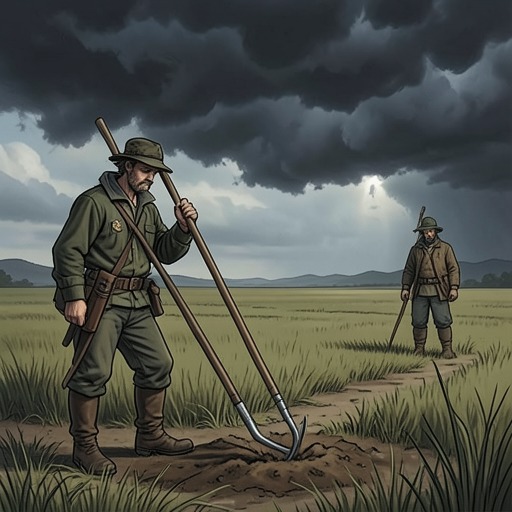
Désormais, la loi, c’est nous qui allons la faire.
Pedro Páramo“Désormais, la loi, c’est nous qui allons la faire.” is don Pedro’s blunt answer when Fulgor Sedano asks what becomes of the law in a dispute over Media Luna’s boundaries. More than a boast, it states the estate’s governing principle: legal language may be used when useful, but don Pedro claims the authority to decide what counts as law and to enforce that decision by force.
The declaration and its occasion
The remark follows a practical disagreement about Toribio Aldrete’s fencing. Aldrete has measured the boundary and asks for the missing stretch of palisade to be put in place. Don Pedro dismisses the matter of fences, insisting that the land has no enclaves, and tells Fulgor to settle the separate business with Lola as quickly as possible. The exchange establishes that the boundary is not being treated as a neutral question of measurement: don Pedro expects his claim to prevail.
When he later instructs Fulgor to visit Aldrete, the issue becomes explicit. Aldrete is to restore the fences to their former position; if he resists, they are to be demolished. Fulgor answers that Aldrete measured correctly. Don Pedro simply directs him to say that Aldrete miscalculated. Fulgor’s question about the law brings the conflict between a recorded boundary and the estate’s power into the open.
Legal language and its limits
The dispute has already been dressed in legal form. Fulgor draws up a declaration identifying himself as a fifty-four-year-old bachelor and estate manager authorized to bring suit, then accuses Aldrete of usufruct. The technical allegation gives the conflict the appearance of a legal proceeding, but Aldrete later ridicules the document as worthless and mocks the ignorance of the patron behind it. The paper thus fails to command even the respect of the person it is meant to pressure.
The episode does not present formal law and outright coercion as separate stages. Don Pedro first directs Fulgor to file an accusation under a legal name, “usufruct” or whatever else occurs to him; he then orders the fences removed if necessary. Legal terminology supplies a façade and a tactic, while the actual outcome depends on who can make the boundary hold. The declaration about making the law names that arrangement rather than concealing it.
Enforcement and the estate’s authority
Don Pedro’s instructions extend beyond the paperwork. He tells Fulgor to remind Aldrete that Lucas Páramo is dead and that new arrangements must be made with him. He also asks whether Fulgor has any crooked men working for the estate and, when Fulgor says there are several, directs him to send them to visit Aldrete. The sequence links property claims to personal intimidation: the estate’s authority is exercised through its manager, its legal accusations, and the men available to enforce its demands.
The declaration is therefore performative in effect. Don Pedro does not merely offer an opinion about law; he gives Fulgor orders that replace Aldrete’s boundary with the estate’s preferred one. The stated rule is followed by instructions to misrepresent the measurement, demolish the fence, and deploy crooked subordinates. The utterance acquires force because the local power to act lies with the speaker, not because the claim has been shown to be legally sound.
Documents, impunity, and significance
The later exchange with Gerardo Trujillo echoes the same confidence from another angle. Gerardo warns that irregularities and testimony known only to don Pedro could become dangerous if they fell into other hands, and advises keeping the papers secure. Don Pedro says he will burn them and asks who could challenge his ownership with or without documents. His assurance makes plain how little he believes paper can restrain him when no effective challenger can enforce it.
Across these episodes, legal records are both tools and liabilities: Fulgor can produce an accusation to advance the estate’s interests, while Gerardo recognizes that documentary evidence may expose irregularities. Don Pedro’s declaration collapses that distinction into a single hierarchy. The law is not an authority above the estate; in practice, it is whatever the estate can announce, impose, and defend. The mocked usufruct accusation, the contested fences, the threatened men, and the papers marked for burning give the phrase its concrete meaning.